Why the form of nitrogen matters more than the kilograms applied: what ammonium is, how your trees assimilate it, how excess ammonium quietly drags down yield, and how to put it right.
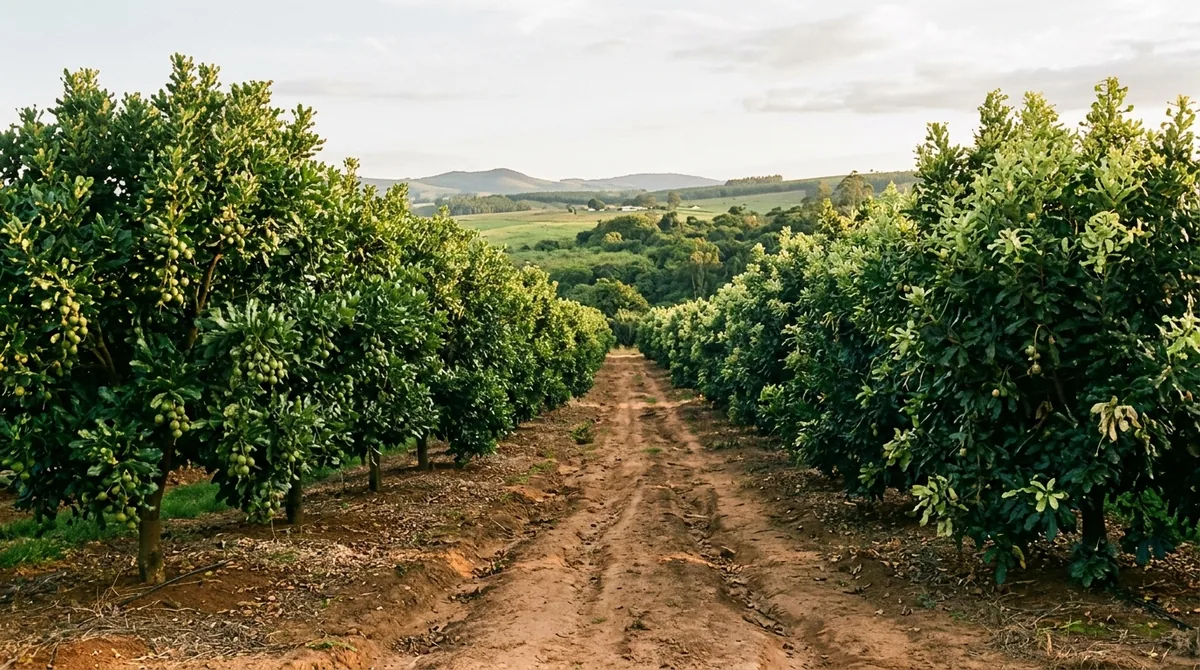
Two macadamia trees across a farm road, on the same fertiliser plan. One converts its nitrogen into balanced growth; the other pushes soft, over-flushed foliage over poor fruit set. The difference is assimilation, not application.
Most orchard nitrogen programmes live or die by one number: kilograms of nitrogen applied per hectare per year. That number matters — but it does not tell you what actually happens inside the tree. Two orchards on identical fertiliser plans, either side of the same farm road, can perform completely differently. One turns its nitrogen into balanced growth, quality fruit and good storage reserves; the other pushes soft vegetative flush, drops fruit, and slowly loses root performance.
The reason is simple: a tree does not experience nitrogen as a tidy spreadsheet recommendation. It experiences a constantly shifting supply of nitrate, ammonium and organic nitrogen, driven by soil moisture, temperature, pH, oxygen, microbial activity, root health and the tree's own energy status. So the question that really decides your season is not how much nitrogen did I apply? It is: how much is actually entering the tree, in what form, and can the tree assimilate it right now? Nowhere does this matter more than with ammonium.
Plants take up nitrogen mainly in two mineral forms — nitrate (NO₃⁻) and ammonium (NH₄⁺). They behave very differently in the soil and inside the tree, and knowing the difference is the foundation of everything that follows.
A negatively charged, mobile anion that travels with soil water to the root and is taken up fast. It cannot build protein directly: the tree must first reduce it to ammonium, an energy-hungry step powered by sunlight. In cool, cloudy weather, unused nitrate backs up in the sap.
A positively charged cation held by soil colloids, so it leaches less and is taken up in the form the tree can use straight away — no costly conversion. The catch: free ammonium inside the tissue is toxic. When uptake runs ahead of assimilation, damage follows fast.
Nitrate moves easily with soil water to the roots and is absorbed quickly. But once inside, it can't build protein until the tree spends photosynthetic energy converting it back down to ammonium — so on dull, cold days a tree keeps drinking in nitrate it lacks the sunlight to process, and it pools in the sap.
Ammonium is positively charged, so it clings to clay and organic matter and leaches far less, and it arrives already in the form the tree needs — no expensive conversion. That efficiency is exactly why it is dangerous. Unlike nitrate, which the tree can park safely in storage vacuoles, free ammonium inside the tissue is toxic: the moment uptake outpaces the tree's ability to lock it into organic compounds, cells start to suffer.
This is why the balance between the two forms — not just total nitrogen applied — is one of the most powerful levers you have. There is no universal right answer: the ideal ratio shifts with crop, cultivar, tree age, soil structure, pH and temperature. Rigid rules like "always use 75% nitrate, 25% ammonium" belong in the bin. Blueberries and other acid-lovers shrug off high ammonium; some citrus rootstocks and stone fruit are acutely sensitive to it.
Here is the part most fertiliser plans ignore. Getting ammonium into the tree is the easy bit. Turning it into something useful is where trees run into trouble.
Trees process ammonium through what plant physiologists call the GS-GOGAT pathway (glutamine synthetase / glutamate synthase). This is the assembly line that takes raw ammonium and builds it into the amino acids, proteins, DNA and chlorophyll the tree is made of. The key reaction looks like this:
That assembly line only runs when three things turn up together:
This ties nitrogen and carbon together inseparably. A tree pulling in a lot of ammonium must have the sugar reserves and the metabolic horsepower to process it. When nitrogen supply is high but photosynthesis is throttled — shading, weeks of overcast weather, a tired canopy — or when roots can't breathe because the soil is waterlogged or compacted, the assembly line stalls. Ammonium keeps arriving; nothing is there to process it; it accumulates and turns toxic.
The crucial point for a grower: this is not really "too much nitrogen." It is a nitrogen–carbon mismatch. That is why you can never separate nitrogen decisions from root health, canopy condition and the tree's energy status. Feed a stressed, shaded or waterlogged tree more ammonium and you are pouring raw material onto a production line that has already shut down.
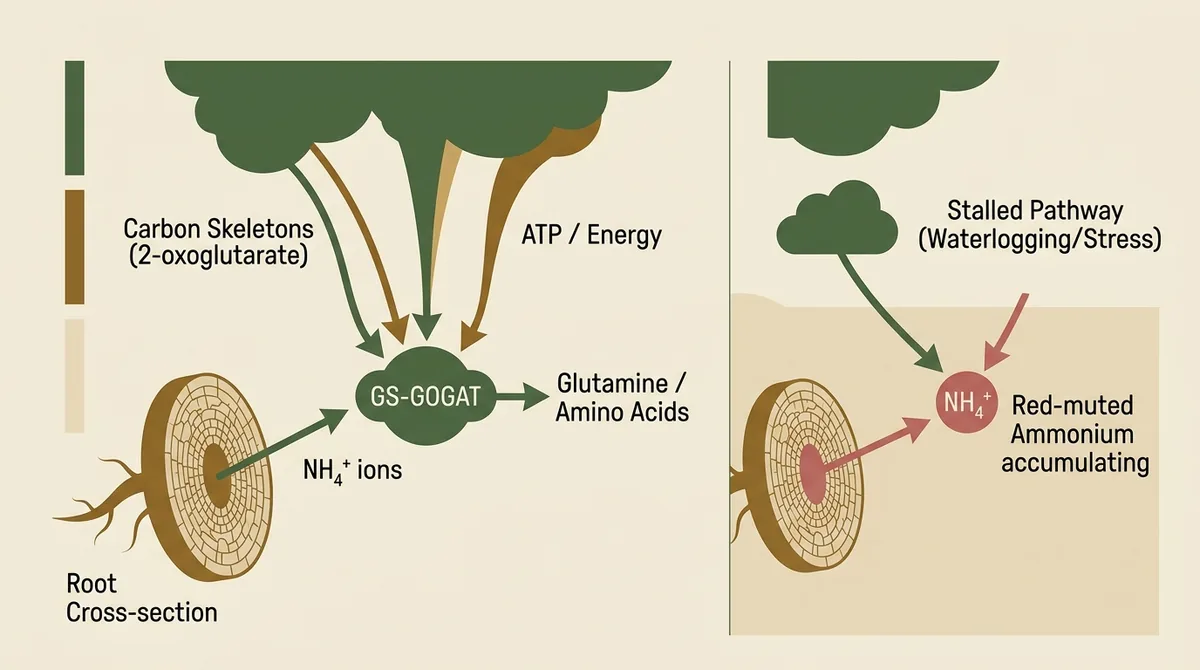
Ammonium entering the root is only useful if carbon skeletons and energy arrive to meet it. When photosynthesis or root respiration falls behind, unassimilated ammonium builds up and turns toxic.
When ammonium piles up faster than the tree can process it, the damage shows up in several ways at once — and most of them look like other problems, which is exactly why it stays hidden.
Depending on the crop and the stress it is under, an ammonium overload has been directly linked to:
How badly this bites depends entirely on the crop. Treat ammonium toxicity as a crop-specific problem, not an automatic penalty for using ammonium fertiliser.
This is the most insidious cost, because it hits trees that look well fed on paper. Ammonium is positively charged, so when it floods the soil solution it competes at the root surface with the other cations — potassium (K⁺), calcium (Ca²⁺) and magnesium (Mg²⁺) — for the same uptake sites, and crowds them out.
The result is maddening: a tree with adequate soil nitrogen, healthy total leaf nitrogen and a perfectly calculated fertiliser history that still shows classic deficiency symptoms — fruit drop from low calcium, yellowing leaves from magnesium lock-out. The problem is not a shortage of fertiliser in the ground; it is how the nutrients compete inside the soil-plant system. You can keep adding calcium and magnesium and change nothing, because the ammonium is standing in the doorway.
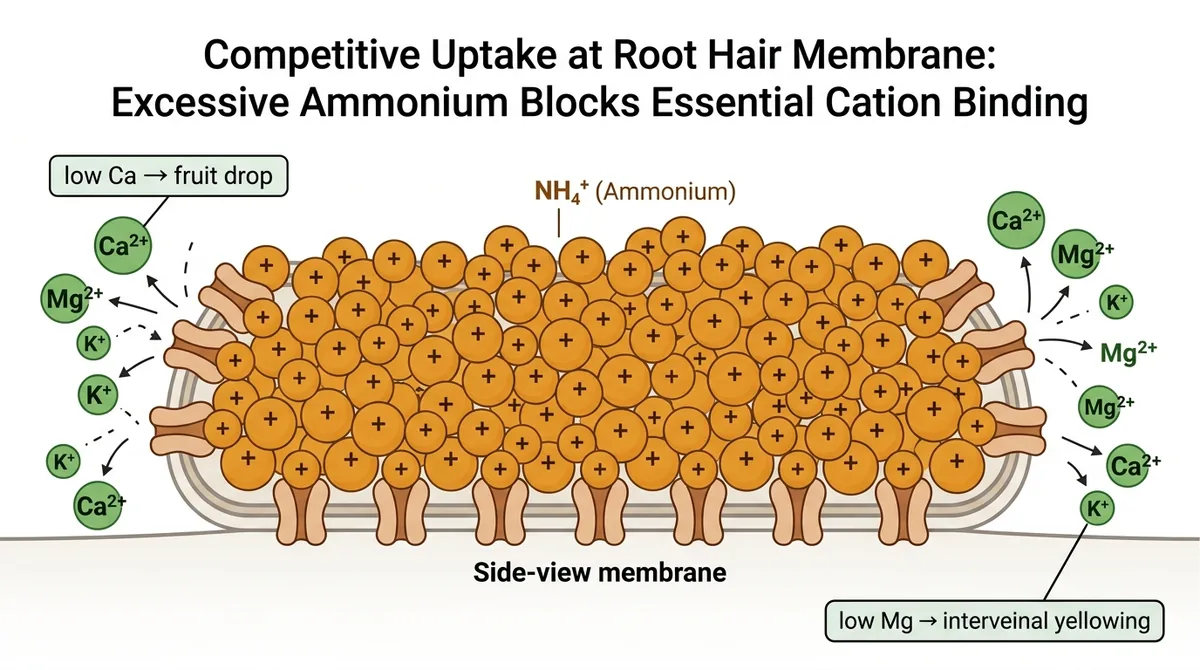
A flood of ammonium ions competes with calcium, magnesium and potassium for the same uptake sites. The tank was full; the tree still could not get what it needed.
Ammonium-heavy programmes push soil pH down through several routes at once: bacteria release hydrogen ions as they convert ammonium to nitrate; roots exude a hydrogen ion every time they take up an ammonium ion; and nitrate leaches away with basic cations like calcium and magnesium, leaving acidity behind. None of this is instant, but over seasons — especially when you apply more than the crop can use — it quietly builds subsoil acidity that throttles roots and worsens every other problem.
Lime (calcium carbonate) is a true liming material: it neutralises acidity and raises soil pH. Gypsum (calcium sulphate) is a different tool entirely — it supplies calcium and sulphur and can improve soil structure, but it generally does not neutralise hydrogen ions or lift pH. Reach for gypsum to fix acidity and you can end up with severe subsoil acidity despite heavy applications. Test pH, correct it with lime, and use gypsum for structure or to supply calcium and sulphur.
Put the three together and you have "yield drag" in the truest sense: a tree fed generously, looking lush, and still underperforming — soft flush instead of fruit, deficiencies you can't fertilise away, and a root zone slowly turning sour.
When sap or tissue tests point to a nitrogen imbalance, the worst move is to react on reflex — cutting off all fertiliser, or dumping on trace elements. Ammonium isn't a bad nutrient; the problem is excess or bad timing when the tree can't keep up. Work through it in order.
Don't rebuild your programme on one odd reading. Check the sample was taken the same way as before — same leaf position, same time of day. Review recent fertigation, rain and irrigation, and ask whether it has simply been an unseasonably cloudy stretch, which alone can pool nitrogen in the sap. Then put a spade in the ground: look at the roots, check for waterlogging and compaction.
Count every source, not just the bag: synthetic fertiliser, compost, manure, fish products, nitrogen fixed by legume cover crops, and mineralisation from soil organic matter. Compare the total against what the crop actually removes at your yields. Over-supply is often hiding in the sources nobody adds up.
If the roots are compromised, changing the blend in the tank won't help. Look for compaction layers, poor drainage, root rot, wild pH swings and salinity spikes. Restoring root respiration and oxygen flow is often the single most effective "nitrogen" intervention you can make — it restarts the very assembly line that processes ammonium.
Go beyond N-P-K. Check pH, the calcium/magnesium/potassium balance (CEC), organic carbon and electrical conductivity. Where you can, use soil respiration to see whether the nutrient cycle has stalled.
No single test diagnoses a nitrogen problem — soil, tissue, sap, what you see in the field, yield and irrigation records have to overlap and point at one cause. If sap ammonium is high, sap calcium is low, soil calcium is adequate and the ground is waterlogged, the story is clear: poor soil physics is driving anaerobic ammonium build-up and cation lock-out. Fix the drainage — don't just spray on calcium.
Dry-matter leaf analysis remains the backbone, but it is a season-long record — it can't tell you whether toxic ammonium is building up this week. That is what plant sap analysis adds: a live read on what is moving through the tree right now.
Tissue testing shows what the tree has banked. Sap testing shows what is currently in its wallet.
Use both — they answer different questionsTreat sap patterns as hypotheses to chase down, not verdicts — a quick field guide to what a reading might mean and what to check next, never a reason to act on the number alone.
| Observed pattern in sap | Possible interpretation | What to investigate next |
|---|---|---|
| High ammonium, poor growth | Ammonium supply is outrunning the tree's carbon/energy capacity to process it. | N rates, root health, soil oxygen and compaction, soil temperature, canopy light. |
| High ammonium, low Mg or K | Cation crowding at the root zone is blocking uptake. | Soil chemistry (CEC balance), fertiliser timing and form, recent soil moisture. |
| High nitrate and high ammonium | Total mineral nitrogen in the soil solution is simply too high. | Overall N budget, recent fertigation, spikes in organic-matter mineralisation. |
| High nitrate, poor growth | Nitrogen is plentiful but assimilation is blocked by another limit. | Molybdenum, iron or sulphur shortfalls; water stress; restricted root respiration. |
| High total N, poor yield | Vegetative/reproductive imbalance — nitrogen is being wasted on flush. | Pruning, hormone balance, the full nutritional picture. |
| Low N, stunted growth | Genuine nitrogen deficiency. | Confirm with tissue analysis, check soil mineral N, rule out root rot (Phytophthora). |
Efficient nitrogen metabolism leans on a supporting cast — molybdenum (the cofactor for nitrate reductase), iron, sulphur, magnesium (the heart of chlorophyll) and the manganese, zinc and copper that run enzyme and antioxidant systems. But they are not silver bullets. A high ammonium reading is not proof the tree is short of manganese, and a molybdenum spray won't clear a bottleneck that is really about waterlogging. Confirm a suspected shortage with soil and tissue tests and a small trial before you commit — blindly dosing trace elements only creates fresh toxicities and antagonisms.
The most resilient orchards pair precise fertiliser management with healthy roots and living soil. A biologically active soil buffers the extremes of any programme, smoothing the timing of nitrogen release — which is why organic matter and cover crops pay off. But biology doesn't repeal the law of replacement: harvest 5 tons of macadamias or 50 tons of citrus and that nitrogen has to go back. Build the whole system to work together:
Yes. A dry-matter leaf analysis reports one total N figure and can't separate nitrogen safely built into proteins from free ammonium doing cellular damage — and it is a season-long historical record, not a live reading. So a tree can show healthy total leaf N while a nitrogen-carbon imbalance, cation lock-out or ammonium build-up quietly limits growth and fruit set. Plant sap analysis is the complementary tool that shows what is moving through the tree right now.
There is no universal number. The best balance depends on crop, cultivar, tree age, soil structure, pH, temperature and the tree's current condition, so fixed rules like "always 75% nitrate, 25% ammonium" should be dropped for context-specific management. Blueberries and acid-lovers tolerate high ammonium; some citrus rootstocks and stone fruit are highly sensitive. The right ratio matches your crop, your soil and the conditions on the day.
Only lime will. Lime (calcium carbonate) neutralises hydrogen ions and raises pH; gypsum (calcium sulphate) supplies calcium and sulphur and can improve structure, but generally does not neutralise acidity or raise pH. Confusing the two is a common, costly error — an orchard can suffer severe subsoil acidity despite heavy gypsum. Test pH regularly, use lime to correct acidity, and gypsum for structure or calcium and sulphur.
Not automatically — a single sap reading is a clue, not a diagnosis. First confirm the sample followed a standard protocol, then review recent fertigation, rainfall and cloud cover, and check root health, compaction and drainage with a spade. Ammonium is not a bad nutrient; the problem is excess or bad timing when photosynthesis or root respiration can't keep up. Often the best fix is restoring root-zone oxygen and drainage, not cutting fertiliser or dosing trace elements.
Nitrogen is essential — but more nitrogen does not mean more production, and assuming it does is a costly mistake. The form matters. The rate and timing matter. The soil the roots live in matters. Above all, the tree's ability to actually assimilate the nitrogen you supply decides whether it becomes fruit or a liability.
Ammonium is not the villain. It is a highly efficient nitrogen source that trees use beautifully when it arrives in the right amount, at the right time, into a tree whose roots can breathe and canopy is working. The danger is excess or bad timing, especially when conditions have already capped the tree's capacity to process it. Stop looking at nitrogen in isolation and start seeing the whole chain — fertiliser → soil solution → microbes → roots → uptake → carbon-driven assimilation → yield. Line those up and nitrogen goes from hidden liability to your most productive input.
Move beyond "How much nitrogen did I apply?" and start asking the question that drives real results: "Is my orchard physically and biologically equipped to capture, assimilate and use the nitrogen I am supplying today?"
The question that changes the programmeA Succession Soils assessment pairs a full SAP analysis with soil health and root-zone diagnostics, so you can tell an assimilation problem from an application one. Book a consultation →
Mike Jackson is the founder of Succession Soils, partnering with commercial orchardists in KwaZulu-Natal and Mpumalanga to restore living soils and rebalance nutrition beneath fruit and nut orchards. His practical work on soil biology and plant physiology draws on the frameworks of Dr Elaine Ingham, John Kempf, Nicole Masters and Dr David Johnson.
Scientific references and further reading: Britto, D.T. & Kronzucker, H.J. (2002) NH₄⁺ toxicity in higher plants: a critical review, Journal of Plant Physiology 159:567–584 · Miflin, B.J. & Habash, D.Z. (2002) The role of glutamine synthetase and glutamate dehydrogenase in nitrogen assimilation, Journal of Experimental Botany 53:979–987 · Hachiya, T. & Sakakibara, H. (2017) Interactions between nitrate and ammonium in uptake, allocation, assimilation and signalling in plants, Journal of Experimental Botany 68:2501–2512 · Hodge, A. & Fitter, A.H. (2010) Substantial nitrogen acquisition by arbuscular mycorrhizal fungi from organic material, PNAS 107:13754–13759 · Irving, T.B. et al. (2021) A critical review of 25 years of glomalin research, New Phytologist · Marschner, P. Marschner's Mineral Nutrition of Higher Plants, Academic Press.
Important scientific note: The evidence for plant sap analysis as a rapid diagnostic tool is promising but remains less universally standardised than conventional dry-matter tissue analysis. Sap results must be interpreted alongside established diagnostic methods rather than used in isolation. The specific effects of biological inputs such as fish hydrolysate or microbial inoculants are highly dependent on field conditions and should not be treated as universally proven, stand-alone solutions.