
Reduce Inputs. Maintain Yield.
Avoid the J-Curve.
Succession Soils is a regenerative soil-health consultancy for commercial macadamia, avocado and citrus orchards in KwaZulu-Natal and Mpumalanga. The Succession Soils Method uses biological science to build living soils that yield ecologically resilient and economically secure commercial orchards.
The Succession Soils Method
Three Pillars of Precision Regenerative Agriculture
We apply biological science to restore living soil ecosystems beneath your orchard—turning complex soil biology and plant nutrition data into practical management actions that build ecological resilience and economic security.
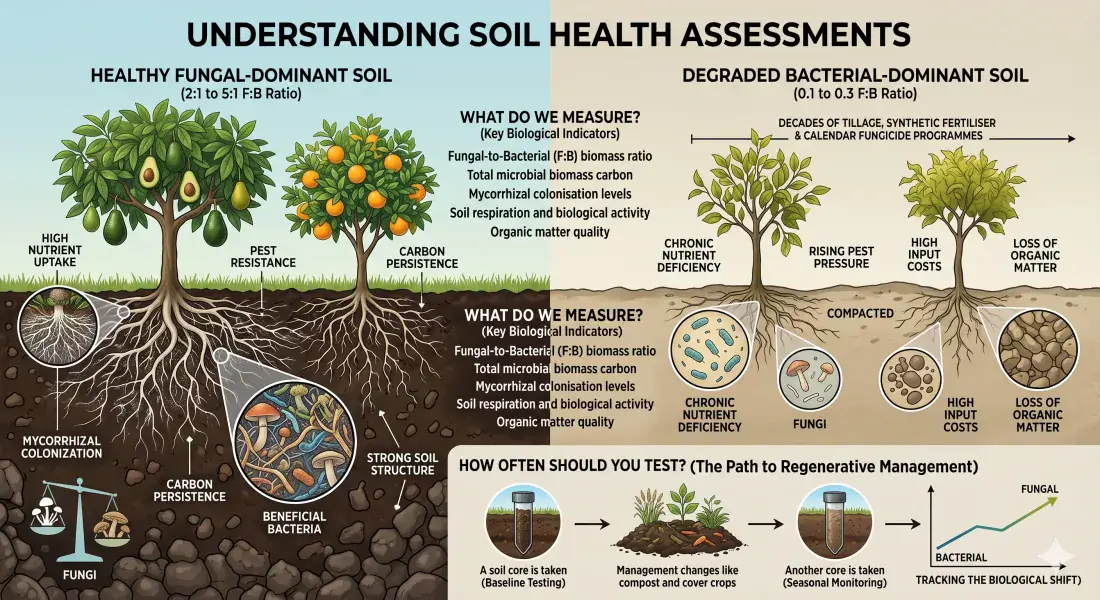
Soil Health Assessments
We measure your orchard's living soil ecosystem—tracking microbial biomass and Fungal-to-Bacterial (F:B) ratio over time to map the biological baseline and guide restoration.2
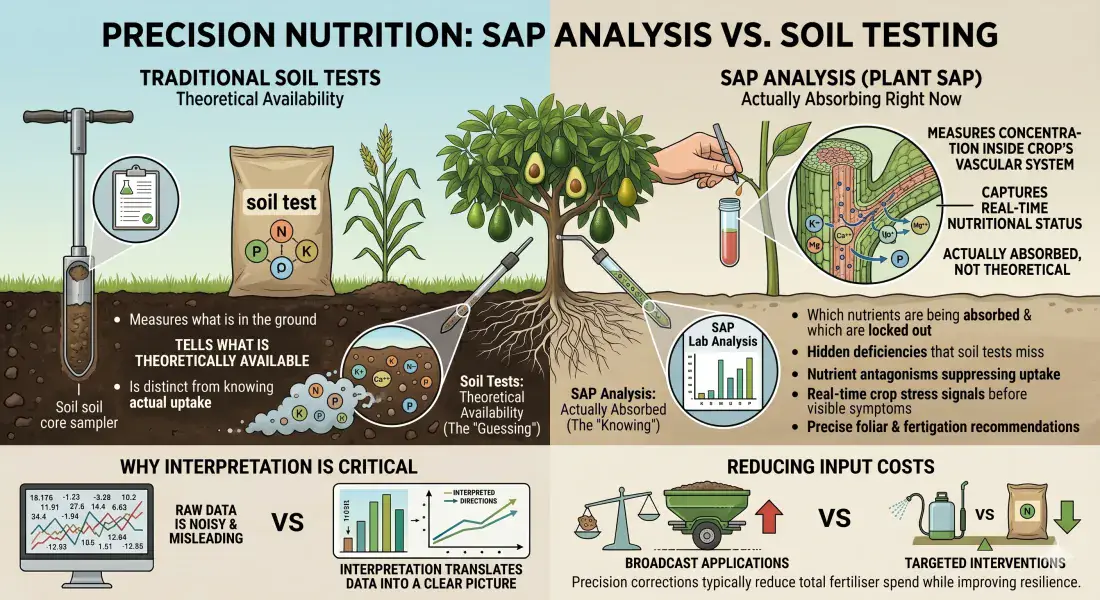
SAP Analysis Interpretation
Raw laboratory SAP data is noisy and confusing. We translate it into precise crop nutrition insights—what your plant is actually absorbing right now, not what is sitting in the soil.
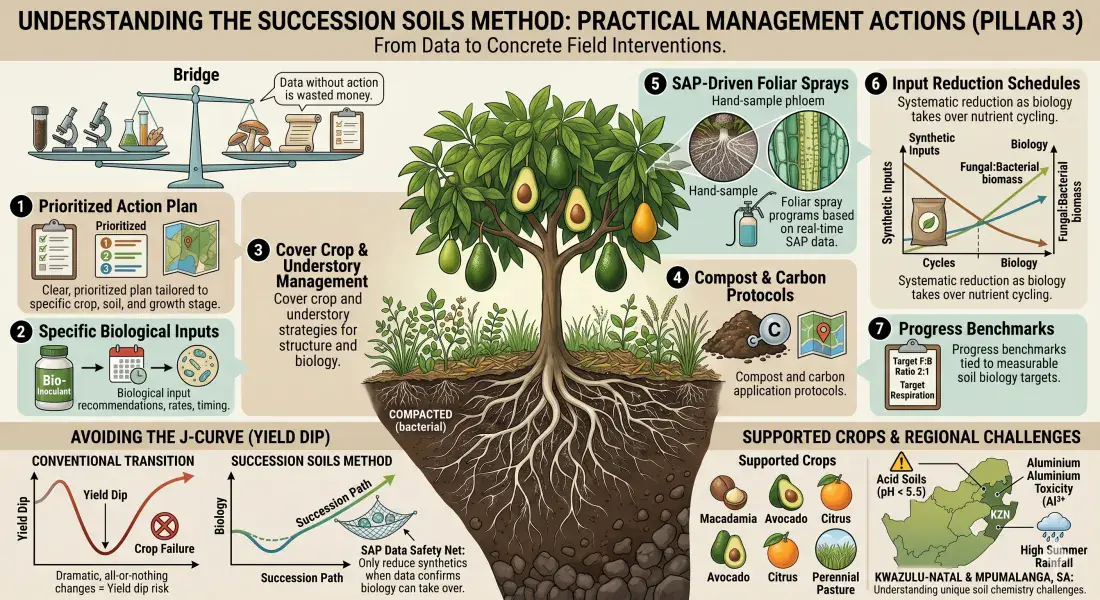
Practical Management Actions
Data without action is wasted money. Every report comes with step-by-step biological interventions you can implement in the field this week.
Working a specific crop? See our soil protocols for macadamia, avocado and citrus orchards.
The Problem We Solve
Why Most Regenerative Transitions Fail
The Transition J-Curve Is Real—But It Is Not Inevitable
During the first 1–3 years of a regenerative transition, farmers typically face high upfront costs and temporary yield reductions while degraded soil biology rebuilds. This is the economic "J-curve"—and it is where most farmers lose their nerve and revert to conventional methods.3
The Succession Soils Method mitigates this risk. By using precision measurement at every stage, we guide your transition so that yields remain stable while your soil biology improves beneath the surface.
- Real-time SAP data catches nutrient gaps before they affect yield
- Soil biology baselines let you measure progress, not guess
- Step-by-step interventions replace risky all-or-nothing changes
- Input costs decline as biology takes over nutrient cycling
Why Soil Biology Matters
The Numbers Behind Fungal-Dominant Soils
Who We Work With
Built for Commercial Orchardists
Our method is designed for serious commercial fruit and nut orchards—macadamias, avocados and citrus—in KwaZulu-Natal and Mpumalanga.
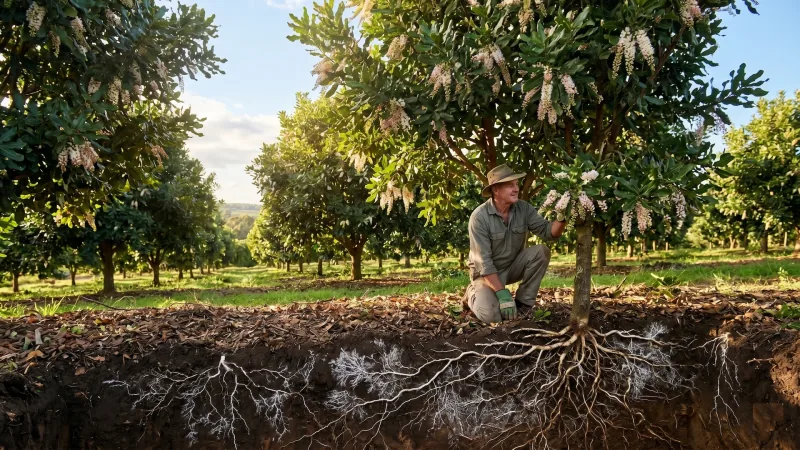
Macadamia Farmers
Macadamias are among the most mycorrhizal-dependent tree crops grown commercially. When fungal networks collapse under heavy tillage and synthetic inputs, the consequences are predictable: Phytophthora root rot gains a foothold, raceme blight intensifies, and heat stress during flowering causes premature nut drop.
The Succession Soils Method rebuilds the natural suppressive biology your macadamia trees evolved to depend on—restoring mycorrhizal colonisation that extends root reach, improving phosphorus uptake without synthetic intervention, and creating a soil ecosystem where beneficial fungi outcompete pathogens rather than chemical sprays doing the work.5
Avocado Growers
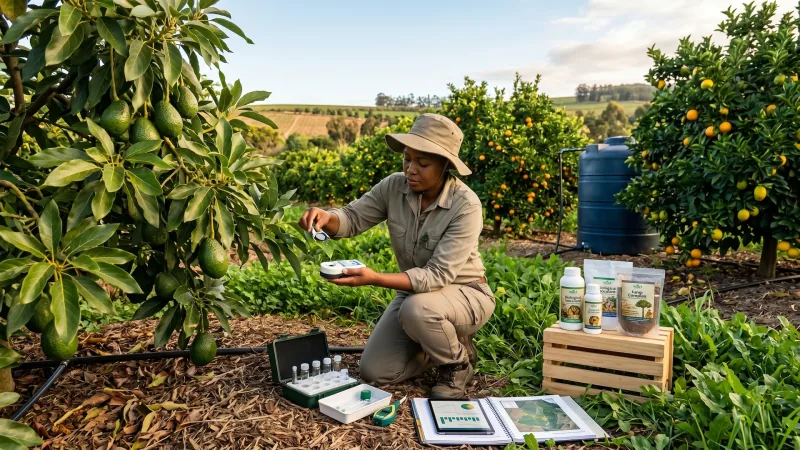
Phytophthora root rot is the single biggest biological threat to avocado orchards in South Africa. Phosphite treatments manage the symptom, but biologically active soil suppresses the pathogen at source—beneficial microbes physically outcompete Phytophthora cinnamomi in the rhizosphere before it reaches the feeder roots.
Beyond disease suppression, mycorrhizal networks dramatically improve water uptake efficiency—critical for avocado growers facing rising irrigation costs and drought pressure. SAP analysis reveals exactly what your trees are absorbing versus what is locked in the soil, allowing you to optimise nutrition for fruit size, oil content and the export-grade quality that commands premium prices.
Citrus Orchardists
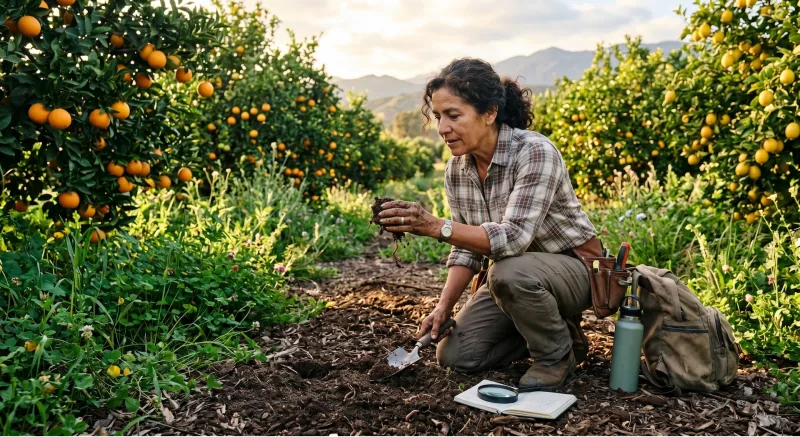
Citrus trees face a convergence of pressures that healthy soil biology directly mitigates: water scarcity during critical growth phases, rising synthetic fertiliser costs, soil-borne pathogens and nematodes that thrive in degraded soils, and the relentless quality standards of the export market.
Soil rich in organic carbon acts as a sponge—improving water infiltration and enabling deeper root development for genuine drought resilience. A diverse soil microbiome naturally cycles nitrogen, unlocks bound phosphorus and delivers the steady, balanced nutrition (zinc, magnesium, iron) throughout the growing season that produces consistent brix levels, healthy rinds and the pack-out rates the export market demands.
Who We Are
Restoring Orchard Ecosystems
Our Mission
To partner with growers in reviving the natural vitality of their land, applying biological science to build living soils that yield ecologically resilient and economically secure commercial orchards.
Our Vision
To secure the future of fruit and nut production by partnering with orchardists to make living, restored ecosystems the standard for the next generation.
Client Results
What Farmers Are Saying
The SAP analysis reports changed everything for us. For the first time we could see exactly what the trees were taking up, not just what was in the soil. Our spray bill dropped 35% in the first season.
I was sceptical about regenerative agriculture because I could not afford a yield dip. The Succession Soils approach gave us the data to transition safely. We maintained production throughout.
The soil biology reports gave me confidence that the biology was actually shifting. Seeing the F:B ratio climb from 0.2 to 1.4 in eighteen months was the proof I needed to keep going.
References
- Strickland, M.S. & Rousk, J. (2010). Considering fungal:bacterial dominance in soils — methods, controls, and ecosystem implications. Soil Biology and Biochemistry, 42(9), 1385–1395.
- Bardgett, R.D. & van der Putten, W.H. (2014). Belowground biodiversity and ecosystem functioning. Nature, 515, 505–511.
- LaCanne, C.E. & Lundgren, J.G. (2018). Regenerative agriculture: merging farming and natural resource conservation profitably. PeerJ, 6, e4428.
- Brundrett, M.C. & Tedersoo, L. (2018). Evolutionary history of mycorrhizal symbioses and global host plant diversity. New Phytologist, 220(4), 1108–1115.
- Akröfi, A.Y. et al. (2015). Biological control of Phytophthora diseases using Trichoderma and mycorrhizal fungi: a review. Journal of Biological Control, 29(2), 67–78.
Common Questions
Frequently Asked Questions
We phase biological interventions alongside your existing input programme and only reduce synthetic inputs when SAP and soil biology data confirm the soil can take over. Real-time SAP testing catches nutrient gaps before they affect yield, so the transition to living soil happens on a data-driven schedule, not a guess.
We track the biological indicators that reveal whether your orchard's soil ecosystem can support resilient production: the Fungal-to-Bacterial (F:B) ratio, total microbial biomass, mycorrhizal colonisation and soil respiration. These living-soil measurements show whether your orchard is feeding itself or relying on inputs to prop up degraded biology.
The Fungal-to-Bacterial ratio measures the balance of fungi to bacteria in your soil. Macadamia, avocado and citrus trees evolved in fungal-dominant soils with F:B ratios of 2:1 to 5:1, yet most South African commercial orchards sit at 0.1 to 0.3. Rebuilding that fungal network is central to restoring orchard ecology.
We work with commercial macadamia, avocado and citrus orchardists in KwaZulu-Natal and Mpumalanga, South Africa. Our management protocols are built around the specific soil ecology challenges of these regions—acid soils, aluminium toxicity and high summer rainfall—though the method suits any commercial fruit or nut orchard.
Stay Ahead of the Curve
Join our monthly newsletter for practical soil biology insights, SAP analysis tips, and transition economics written for commercial farmers.