Three biostimulants you keep hearing about, explained in plain terms. What each one actually is, how it works on the plant, and how to use all three safely on macadamias, avocados and lemons.
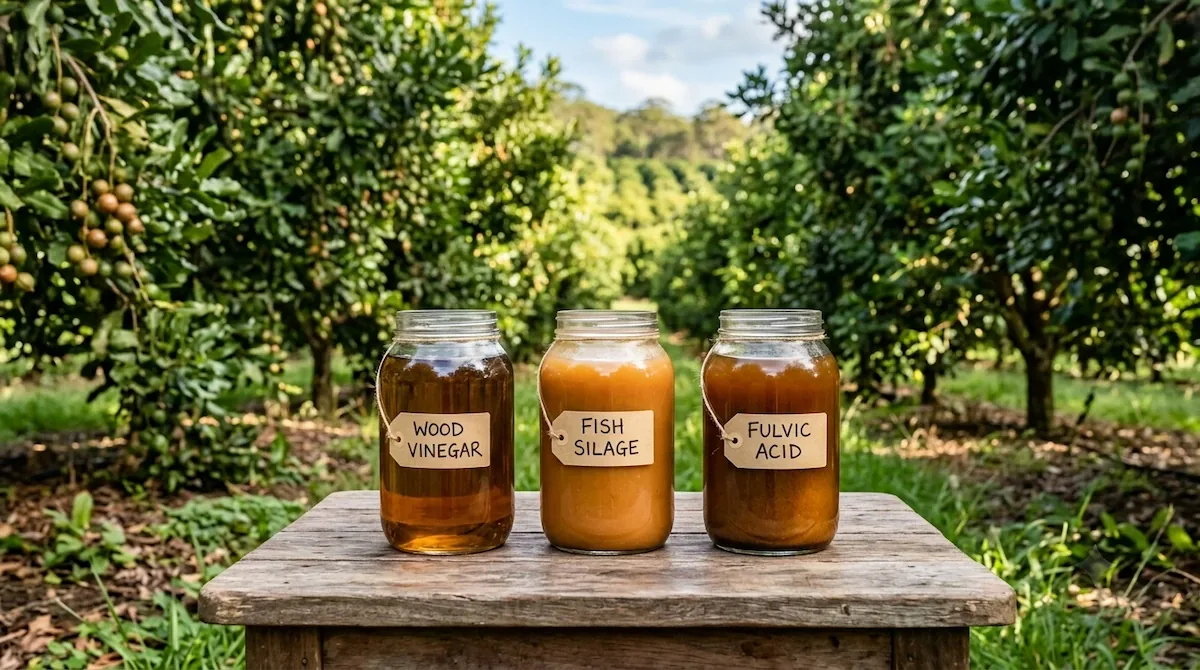
Wood vinegar, fish silage and fulvic acid turn up in almost every conversation about biological farming. They are genuinely useful tools — and also widely misunderstood, wrapped in marketing claims that do not hold up. This article strips it back to what matters: what each product is, how it works on the plant, and how to put all three on your orchard without burning a leaf.
What it is. Wood vinegar is the liquid you capture when you make charcoal. When wood is heated in a low-oxygen kiln, it gives off smoke and vapour. Cool that vapour down and it condenses into a dark, sharp-smelling liquid. That liquid is wood vinegar, also called pyroligneous acid.
It is mostly water — around 80 to 90 percent — with the rest made up of a mix of organic acids, phenols and other small compounds cooked out of the wood.1 Acetic acid is the main one, which is why it is so acidic, usually sitting at a pH between 2.5 and 3.7. The phenols — compounds such as guaiacol and syringol that come from the breakdown of lignin — are the part that carries most of its antimicrobial punch.
Wood vinegar is a distillate. It is condensed from smoke, so it carries only the light, volatile compounds that can travel as vapour. It does not contain proteins, amino acids or humic substances — those are heavy molecules that stay behind in the char or are destroyed by the heat. If a label claims a wood vinegar is feeding your trees amino acids, treat the rest of that label with caution.
How it works. Wood vinegar does its job in three ways. First, the acids and phenols act as a mild stress signal on the plant. A small, controlled dose nudges the tree to switch on its own defence responses without doing any real damage — the plant behaves as if a threat is near and prepares for it.2 Second, those same phenols suppress a range of fungi and bacteria on the leaf and in the soil, which is why growers use it as part of a disease programme.
Third, and most useful in practice, wood vinegar lowers the surface tension of water. A tank with a little in it wets the leaf evenly and spreads into the tight spaces instead of beading up and rolling off. That makes it a natural wetting agent that helps everything else in the tank make better contact with the leaf. This is a real, measurable effect. The old story about wood vinegar "shrinking water clusters" is not — judge the product on its wetting and coverage.
In the soil, a dilute drench shifts the balance of soil life. It knocks back some soil-borne fungi and nematodes while leaving room for the beneficial microbes you want to build up. Used sparingly, it is a soil conditioner as much as a spray additive.
What it is. Fish silage is whole fish or fish offcuts broken down into a thick, nutrient-rich liquid. Instead of cooking the fish, which destroys a lot of the good material, the fish is minced and mixed with a small amount of organic acid — usually formic acid — which drops the pH to around 3.5 to 4.0.3 At that acidity, spoilage bacteria cannot grow, but the fish's own digestive enzymes keep working. Over a few weeks those enzymes chop the fish proteins into small peptides and free amino acids.
The result is a stable liquid that keeps for a long time without refrigeration and needs no neutralising before you use it. It carries the full mineral profile of the fish — nitrogen, phosphorus, potassium, calcium, magnesium and a spread of marine trace elements — in a form the plant can take up easily.
How it works. The real value of fish silage is the amino acids. Normally a plant has to spend a lot of energy building its own amino acids: it pulls in nitrate from the soil, converts it step by step, and only then assembles the building blocks it needs. Fish silage hands those building blocks over ready-made. The plant skips the expensive part and gets straight to growing.4
Some of those amino acids do double duty. Glycine and glutamic acid feed straight into chlorophyll production, which is why a fish spray so often greens up pale foliage. They also act as natural chelators — they wrap around metal micronutrients like iron and zinc and help carry them across the leaf and cell membranes. As a soil drench, fish silage feeds the soil biology directly: the carbon and nitrogen set off a bloom of the microbes that cycle nutrients in the root zone.
Fish silage is exactly the kind of input that suits our coastline — it is made from marine material that would otherwise be waste. This is the product family produced by Oceanic Organics here in KwaZulu-Natal, so a quality hydrolysate is available close to the farm rather than shipped in from elsewhere.
What it is. Fulvic acid is the smallest, most active part of the humic family — the dark, carbon-rich material left behind when organic matter breaks down over a very long time. It is drawn from old deposits such as peat and leonardite. What sets it apart from its bigger cousin, humic acid, is that fulvic acid dissolves fully in water at any pH, including strongly acidic mixes.5 That single property is why it blends cleanly with acidic inputs like wood vinegar and fish silage instead of falling out of solution.
The molecule is covered in reactive chemical groups that carry an electrical charge. Those charges give fulvic acid a very high capacity to hold and swap nutrient ions, and they make it a strong natural chelator.
How it works. Fulvic acid does two jobs. The first is carrying nutrients. It grabs onto metal micronutrients — iron, zinc, manganese, copper — and locks them into small, stable, charge-balanced packages that a plant recognises and absorbs without a fight. Loose minerals that would otherwise get tied up in the soil or on the leaf surface stay available.
The second job is opening the door. Because the molecule is so small and carries that charge, it slips through the waxy leaf layer and works on the cell membrane, making it easier for nutrients applied alongside it to move in.6 Growers call it a "cell sensitiser" for this reason: add a good fulvic acid to a foliar spray and more of what you paid for ends up inside the plant. It also mops up the harmful by-products that build up in a stressed tree, helping it hold up through heat and drought.
Each product covers a different job, and they line up neatly. Fish silage brings the food — the amino acids and minerals. Fulvic acid is the carrier and the door-opener, moving that food into the plant. Wood vinegar is the wetting agent and the defence signal, spreading the spray evenly and keeping the fast new growth tough rather than soft and disease-prone.
They also mix without fighting each other. All three are stable in acid, so blending them does not cause the marine nutrients to clump or drop out of solution the way they would in an alkaline tank. A common concentrate ratio is 40 parts fish silage : 40 parts fulvic acid : 15 parts wood vinegar. In that blend the wood vinegar is the ingredient that sets the safety ceiling — it is the most likely to burn a leaf — so you dilute the whole mix to keep the wood vinegar gentle, and the fish and fulvic land in their right range on their own.
The table below shows where a 40:40:15 concentrate lands at common dilutions. These are the starting points; the crop section that follows tightens them where a crop needs more care.
| Use | Concentrate in Water | Rough Dilution | Wood Vinegar on the Leaf |
|---|---|---|---|
| Strong foliar feed | 1.5 L per 100 L | ~1:65 | ~0.24% |
| Routine foliar feed | 1.0 L per 100 L | ~1:100 | ~0.16% |
| Soil drench | 0.63 L per 100 L | ~1:150 | ~0.10% |
The three crops do not have the same tolerance. Macadamias are the toughest, avocados are the most delicate, and lemons sit in between with a soft spot at flowering and on young fruit. Get the rate right for the crop and the timing right for the season, and these inputs are safe. Get either wrong and the acidity will cost you leaves.
Macadamia leaves are thick and leathery, so they handle a foliar spray better than most tree crops. A routine feed at around 1:100 of the blend during active leaf growth is a sound starting point, and you can lean towards the stronger 1:65 rate on healthy, hardened foliage when you want a bigger push. The one hard rule is the flowering window: the racemes are delicate, and an acidic spray during bloom can knock flowers and upset pollination. Feed before and after flowering, not during it.
Avocados are the crop to be careful with. They have thin leaf cuticles and a shallow, easily stressed root system, and an acidic spray at full strength will scorch them. Keep the blend light — no stronger than roughly 1:150 to 1:200, so the wood vinegar on the leaf stays near 0.1 percent — and never spray in the heat of the day or when the trees are stressed. Avoid flowering and fruit set entirely. On avocados, a gentle 1:150 soil drench is often the safer way to get the benefit without risking the canopy.
Mature lemon leaves have a thick, waxy skin that copes well with a foliar feed. The soft points are the young flush and the developing fruit. Acidic sprays can mark the rind — the oil glands in citrus skin rupture and spot easily — and they can trigger flower or young fruit drop. Stick to the weaker end, around 1:100 to 1:150, during active leaf growth, and keep the spray off the trees during bloom and early fruit. Once the fruit has set and sized a little, a routine feed is fine.
| Crop | Risk Level | Foliar Rate (Blend) | Soil Drench | When to Hold Off |
|---|---|---|---|---|
| Macadamia | Moderate | 1:100 routine, up to 1:65 on hardened leaves | 1:150 | During flowering (protect the racemes) |
| Avocado | High | 1:150 to 1:200, kept light | 1:150 (preferred route) | Flowering, fruit set, and any hot or dry day |
| Lemon | Moderate | 1:100 to 1:150 | 1:150 | Bloom and early fruitlet stage |
Whatever the crop, the same handful of habits keeps you out of trouble. None of this is complicated; it just has to be done every time.
Every orchard has its own soil, microclimate and tree health. The rates here are safe, sensible starting points drawn from broad practice — not a fixed recipe for your block. Start on the weak side, watch how your trees respond, and adjust from there. If in doubt, spray weaker and more often rather than stronger and less.
Wood vinegar is a distilled acid that wets the leaf, signals the plant to defend itself, and holds back disease. Fish silage is digested fish that delivers ready-made amino acids and a full mineral load the plant can use with little effort. Fulvic acid is a small carbon carrier that chelates micronutrients and helps everything else cross into the plant. Together they cover food, delivery and protection in a single tank, and because all three are stable in acid they blend without falling apart.
The blend is only as good as the way you apply it. Dilute to keep the wood vinegar gentle, buffer the tank towards pH 5.5 to 6.0, and match the rate to the crop — full-strength on hardened macadamia leaves, light and cautious on avocados, and off the trees while lemons are in bloom. Test a few trees, spray in the cool, and build from the weak end. Done that way, these three inputs are among the most useful tools you can keep on the farm.
Wood vinegar is a distilled acid, fish silage is a digested protein, and fulvic acid is a carbon carrier. They are not substitutes for each other — each does a different job on the plant, which is why stacking them wrongly wastes more than money.
Pyroligneous acid: the liquid condensed and distilled from wood as it is charred. It is the first of the three covered here, with an explanation of how it acts on the plant and where it fits alongside the other two.
They do work well together, and there is a section here on why. The real constraint is application rather than chemistry: getting them on safely every time, and respecting the crop. Avocados in particular are flagged as high risk and want a light spray.
Macadamias have robust leaves and fragile flowers, and that distinction is what decides your timing. What the leaf tolerates comfortably, the flower may not, so a rate that is routine outside flowering is not automatically safe during it.
Biostimulants work best when they answer a real shortfall — not when they are sprayed on spec. A SAP analysis shows you what your trees are short of and what they have plenty of, so every spray earns its place in the programme.
Book a SAP Analysis