When the rains fail, the real story is underground. This article explains how fungal-dominant soils hold water, protect roots, and buffer perennial tree crops against drought — and what it means for macadamias, avocados, and citrus in KwaZulu-Natal.
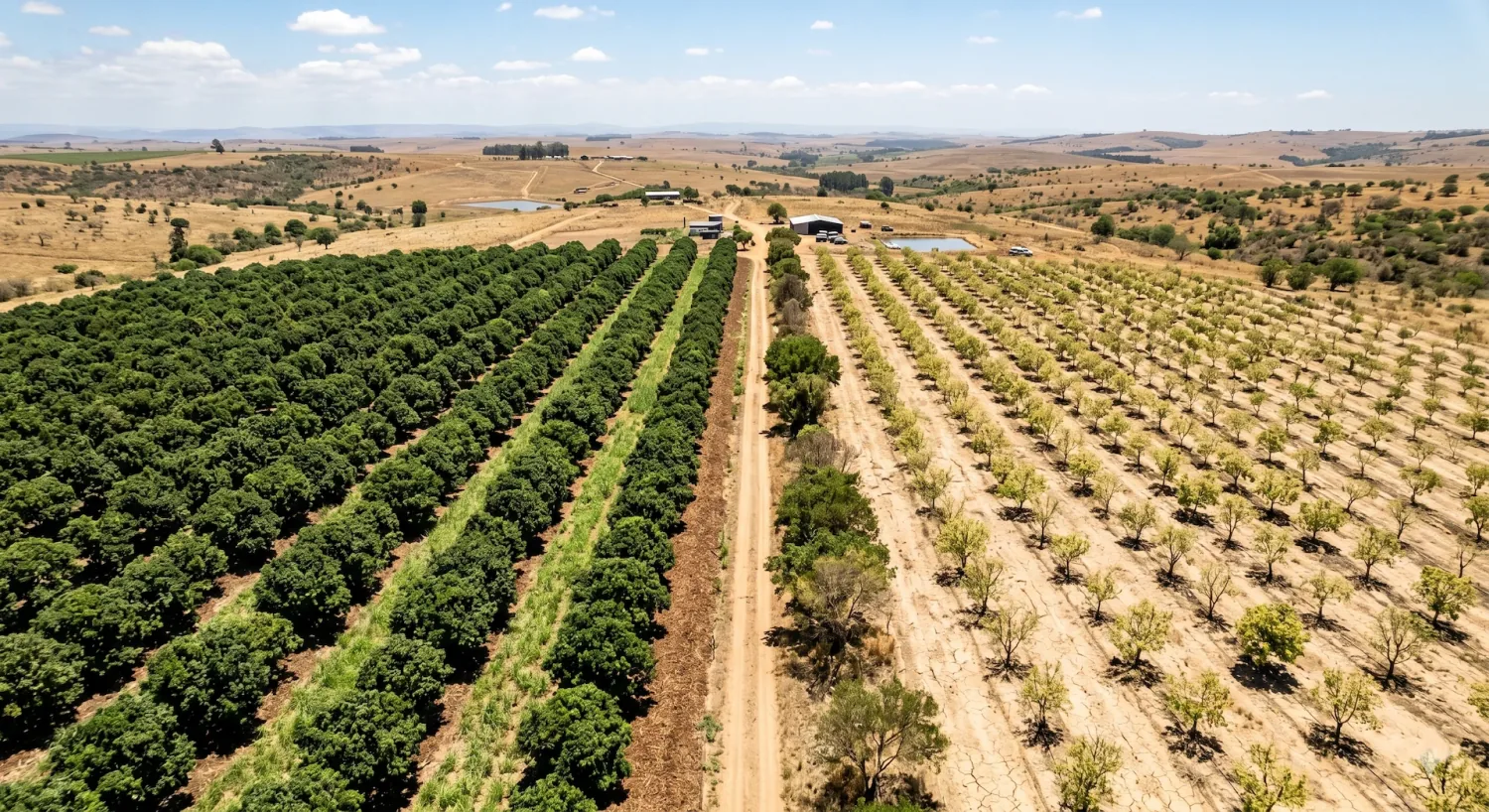
Some orchards absorb a dry spell and keep producing. Others show stress within days — leaf scorch on avocados, premature nut drop in macadamias, fruit split in citrus. The gap is almost never explained by what is above the soil surface. This article explains how the fungal-to-bacterial ratio shapes your orchard’s drought vulnerability — and what you can do about it before the next dry season arrives.
When the rains fail, most orchardists look upward — at the sky, at the canopy, at the irrigation gauge. The real story, though, is underground.
Growers in the same district, with the same variety, the same rainfall pattern, and similar irrigation infrastructure, can produce vastly different outcomes. The explanation most growers are not yet working with is the fungal-to-bacterial ratio (F:B ratio) — the balance between fungal and bacterial populations in the soil — and the physical architecture that a fungally dominant soil builds over time.
All soils contain both bacteria and fungi. In conventionally managed orchards — where decades of tillage, bare inter-rows, synthetic nitrogen inputs, and herbicide applications have shaped the soil environment — the balance typically shifts toward bacterial dominance.1,9 Bacteria are fast-cycling and efficient at releasing nutrients, but they leave behind very little physical structure.
Fungi work differently. Fungal hyphae — the microscopic threads that make up the bulk of fungal biomass — physically bind soil particles together into stable clumps called aggregates.2 These aggregates are the structural units of a healthy soil. They create a network of pore spaces that holds water, allows air to move, and gives roots room to explore.
For long-lived tree crops like macadamias, avocados, and citrus, the F:B ratio is not an academic measurement. It is a direct predictor of how your orchard behaves under hydrological pressure.
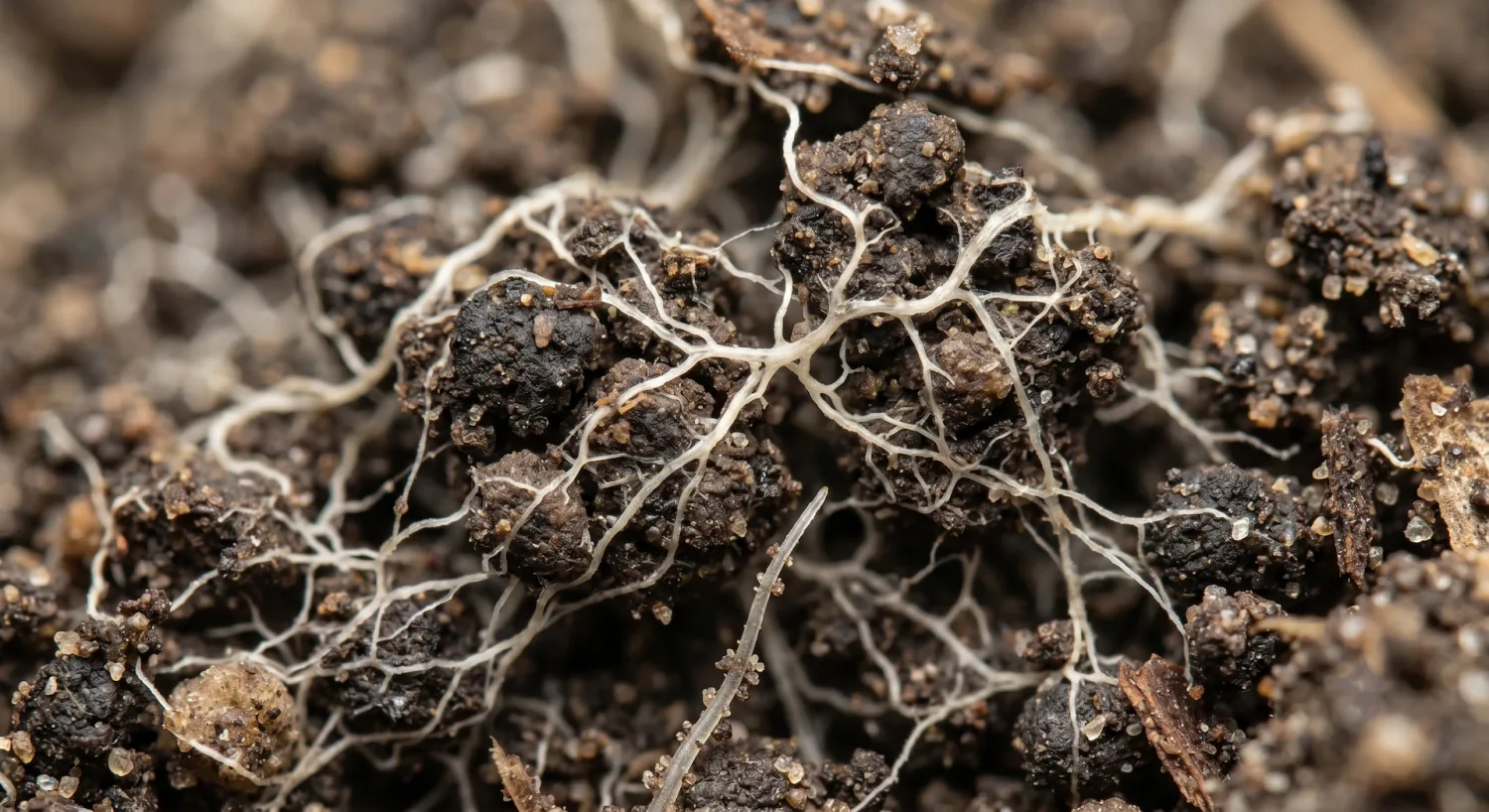
The moisture advantage in a fungal-dominant soil is not a single effect. It comes from three separate but connected mechanisms.
When fungal hyphae bind soil particles, they create a two-layered pore system — large pores between aggregates that drain rapidly after rain (allowing oxygen back in) and small pores within aggregates that hold water against gravity. This plant-available water is what keeps tree roots hydrated between irrigation cycles or rainfall events. A structurally healthy soil holds significantly more plant-available water per centimetre of profile depth than a compacted, low-biology soil of the same clay content.2
Mycorrhizal fungi produce a sticky glycoprotein called glomalin. It coats soil aggregates and makes them water-stable. When rain or irrigation hits a glomalin-rich soil, aggregates hold their shape instead of collapsing into a slurry that seals the soil surface. Water infiltrates rather than running off.3
Glomalin-related soil protein (GRSP) is a significant contributor to stable soil organic carbon — though its precise share varies widely depending on ecosystem type, soil depth, and extraction method.4 What is consistent across the research is that it functions as both a carbon storage mechanism and a physical infiltration aid that no fertiliser programme can replicate.
Fungal hyphae extend far beyond the reach of root hairs — in some cases several metres from the root zone. Under dry conditions, they can access moisture in distant or deeper soil horizons and move it toward the root. This is a direct contribution to tree water status that no irrigation upgrade can fully replace if the biology is not present to do it.5
Macadamia integrifolia and M. tetraphylla evolved in the subtropical rainforest margins of eastern Australia — fungal-rich, organically complex environments. Their natural association with fungal communities runs deep. In managed orchards, however, that relationship is frequently broken by soil disturbance, chemical inputs, and bare tree rows.
Macadamias have two critical water-demand windows: the period around flowering and early fruit set, and the nut-fill stage approximately four to six weeks into kernel development. Water deficit at either point reduces kernel mass and NIS weight — the measure that determines your commercial return.10
In a fungal-dominant soil, the buffering effect works on two fronts. Hyphal networks maintain higher tree water potential for longer into a dry spell. And improved soil structure means that when rain arrives, more of it infiltrates rather than running off the compacted inter-row. The profile recharges faster and holds more per millimetre of rainfall.
Physiologically stressed trees — those running low on water and struggling to maintain turgor — are more vulnerable to opportunistic pathogens like Phytophthora and Botrytis.6 By helping trees maintain better water status through dry periods, fungally active soils reduce the physiological stress that opens the door to disease. The soil biology supports the tree’s own defence systems — it is not an afterthought.
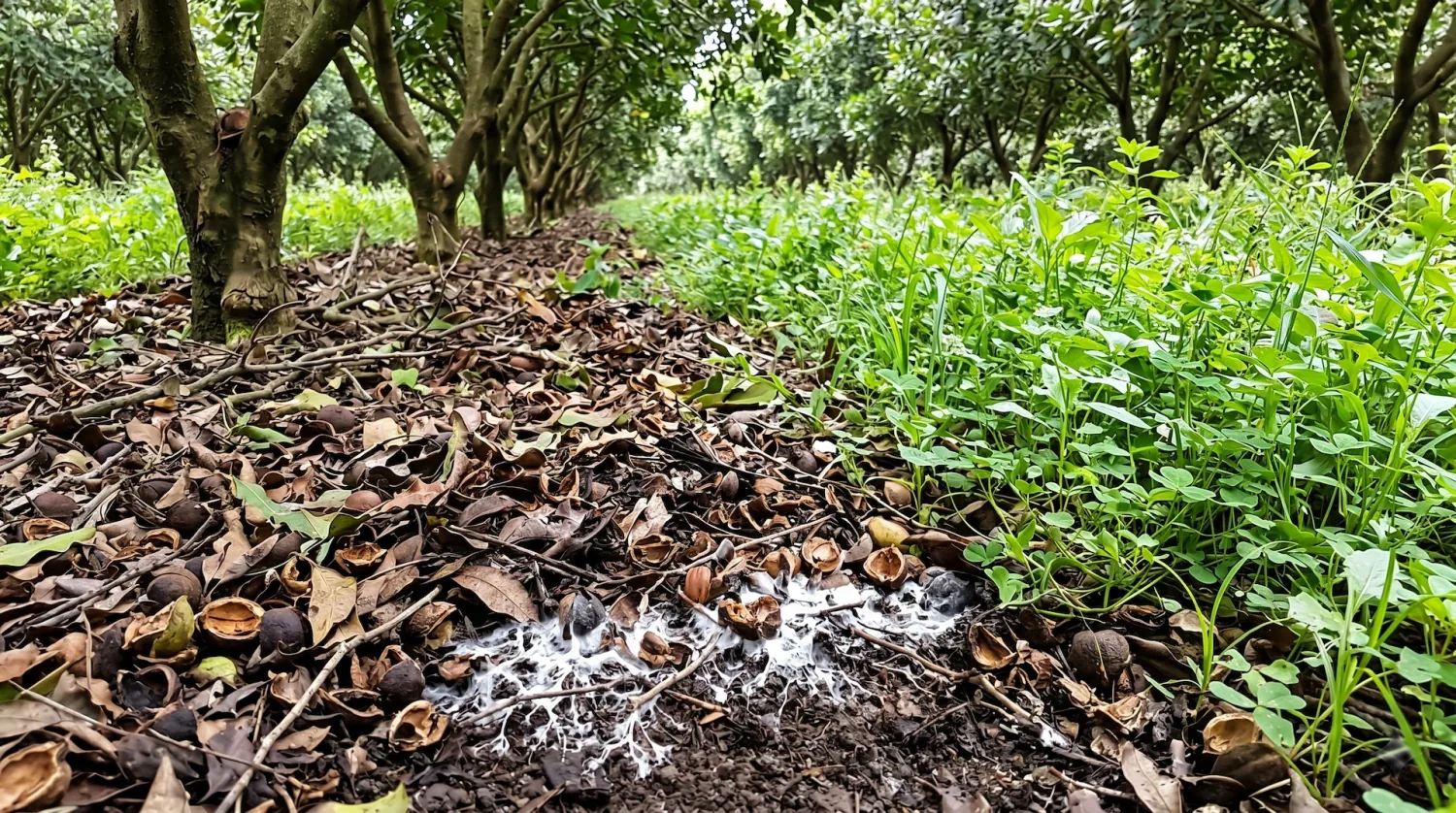
Avocados are among the most water-sensitive tree crops in commercial production. Their root systems are shallow, non-woody, and limited in their ability to explore large soil volumes. The condition of the soil they do occupy is therefore critical.
A compacted, bacterial-dominant avocado soil creates a paradox: low water-holding capacity and poor drainage at the same time. After rain, water sits at the surface and is rapidly lost to evaporation. In between events, roots experience near-drought conditions. The tree swings between waterlogging and desiccation within the same week — and both extremes cause root damage.
Fungal-dominant soils under avocados perform differently on both counts. Stable aggregate structure prevents waterlogging by maintaining pore continuity through rain events. Glomalin-stabilised aggregates resist slaking. And mycorrhizal associations — which avocados form readily in appropriate conditions — extend effective root depth and exploration significantly beyond what the root system can achieve alone.
Phytophthora cinnamomi, the root rot pathogen responsible for enormous losses in avocado production globally, is consistently suppressed in soils with high fungal diversity and competitive biological activity. Trichoderma species, competitive saprophytic fungi, and diverse hyphal networks create a soil environment that is physically and biologically hostile to Phytophthora establishment.6 A fungal-dominant soil is not just a more drought-tolerant soil. It is a more disease-resistant one.
Citrus forms associations with arbuscular mycorrhizal fungi (AMF) — a group that creates direct connections between the fungal network and the cells inside the root. These associations produce measurable improvements in drought tolerance, phosphorus uptake efficiency, and root pathogen resistance.7
The complication in citrus is that high rates of soluble phosphorus — applied consistently over many seasons, as is common in conventional citrus nutrition programmes — suppress AMF colonisation. When available phosphorus is high, the tree has no biological incentive to maintain the relationship with its fungal partners. Colonisation drops.8 The hyphal network thins. And over time, the tree becomes reliant on applied inputs rather than the soil system.
Re-establishing meaningful AMF associations in citrus takes time — typically two to three seasons of reduced soluble phosphorus input, combined with organic matter and biological inoculant applications. A soil health assessment that measures biological indicators alongside chemistry will tell you whether this is the limiting factor in your orchard and what the pathway forward actually looks like.
The most common causes of low F:B ratios in KwaZulu-Natal tree crop orchards are well-documented:
Rebuilding fungal dominance is a stepwise process. It starts with reducing the inputs that suppress it. It continues with providing the complex carbon that fungi need — permanent groundcovers, organic mulches, and biologically active amendments. And it requires monitoring. Without a baseline measurement of F:B ratio, organic matter quality, and biological activity, you have no way of knowing how far the system is from where it needs to be, or whether your interventions are working.
This is where a professional soil health assessment changes what is possible. Without data, you are guessing. With it, you have a pathway.
If your orchard has struggled through recent dry seasons, or if you are watching irrigation costs rise without a matching improvement in productivity, the limiting factor is almost certainly below the soil surface.
Succession Soils conducts independent soil health assessments for macadamia, avocado, and citrus orchards across KwaZulu-Natal and beyond. Our assessments cover biological, chemical, and physical indicators — and they are designed to produce a practical action plan specific to your operation, not a generic report.
Book your soil health assessment at successionsoils.co.za or contact us directly to discuss what an evaluation would look like for your orchard.
The resilience your orchard needs is built in the soil. The first step is knowing whether it is there.
Through three mechanisms. Fungal hyphae bind soil into aggregates, which creates the pore space that stores water. Glomalin waterproofs and stabilises those aggregates so they survive wetting and drying. And the hyphae themselves transport water, extending the reach of the root system beyond where roots alone can go.
A glycoprotein produced by mycorrhizal fungi that binds and waterproofs soil aggregates. It is a large part of why a fungal-dominant soil keeps its structure through repeated wetting and drying instead of slumping and capping over.
All three, and each is treated separately here, because the benefit shows up differently in each. All are perennial tree crops that evolved alongside mycorrhizal associations, so all three respond — but macadamias, avocados and citrus have different root architecture and different drought failure modes.
Broadly, the practices that suit an annual cropping system: repeated cultivation, bare ground, and high-analysis soluble inputs. They work against exactly the fungal networks a perennial orchard depends on. What rebuilds it is covered in the same section.