A bare orchard floor is a wasted asset. The right plants growing between and under your trees will feed the soil, fix your nutrition problems and cut your input bill. Here is how it works — across macadamias, avocados, citrus, litchis and mangoes.
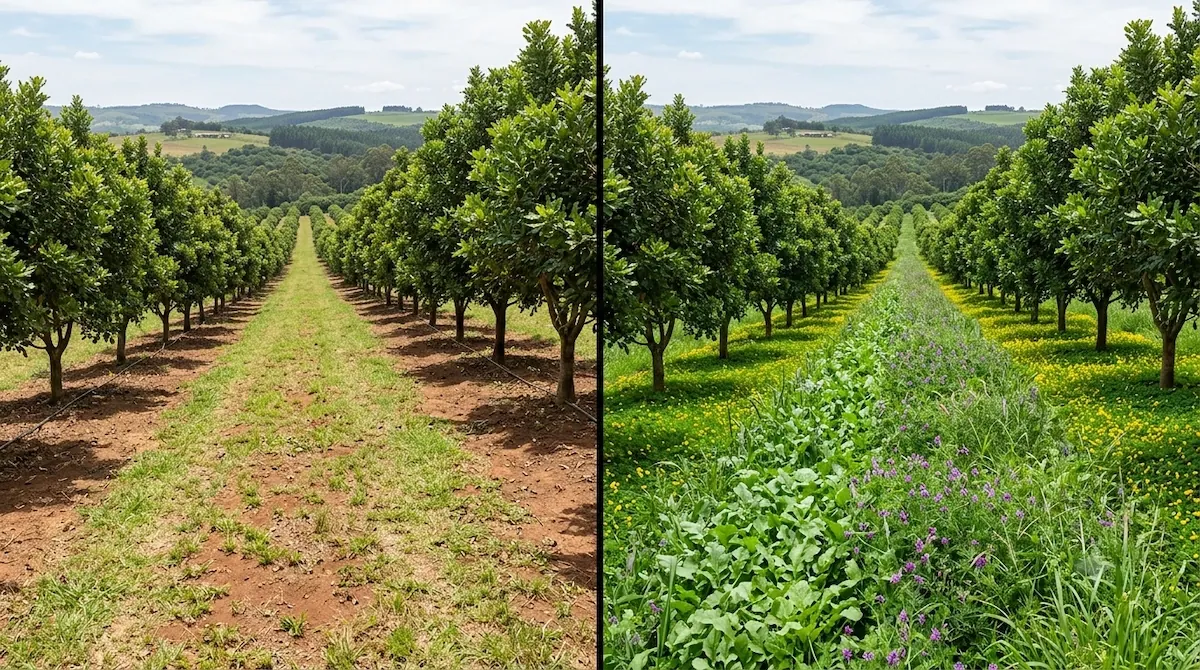
Most growers were taught to keep the orchard floor clean — bare soil, sprayed off, easy to walk and drive on. It looks tidy. But bare soil is dead soil, and dead soil costs you money every season: in fertiliser, in water, and in lost yield. A cover crop turns that same floor into a working part of the farm. This article explains what cover crops are, how they do their job, and what they change for macadamias, avocados, citrus, litchis and mangoes here in KwaZulu-Natal.
A cover crop is a plant you grow to feed the soil, not to sell. Some people call them green manures, catch crops or living mulch. You plant them between the tree rows, or right under the canopy, and you manage them for what they do to the ground — not for a harvest.
They come in two broad types. Living covers stay in place all season and keep the floor green. Terminated covers are grown, then knocked down — mowed, rolled or left to die back — so the plant material breaks down into the soil as food.
The idea is simple. You are no longer farming only the trees. You are farming the soil that feeds the trees. And soil, left bare under a KZN summer sun and heavy rain, falls apart fast. It bakes, it crusts, and it washes down the slope. A living root system holds it together and keeps it working. No single plant does everything — the trick is choosing the right species, usually a mix, for the job your orchard needs most.
Compacted soil is one of the biggest hidden problems in KZN orchards. When the ground is packed hard, roots cannot push through it, air cannot move, and rain cannot soak in. Instead the water runs off, taking your topsoil with it.
Most growers reach for a ripper. The trouble is that ripping does not last. On one tour of macadamia, avocado and citrus farms, growers watched soil that had been carefully prepared get pressed back to 80% of its old hardness by the very first tractor wheels that drove over it.1
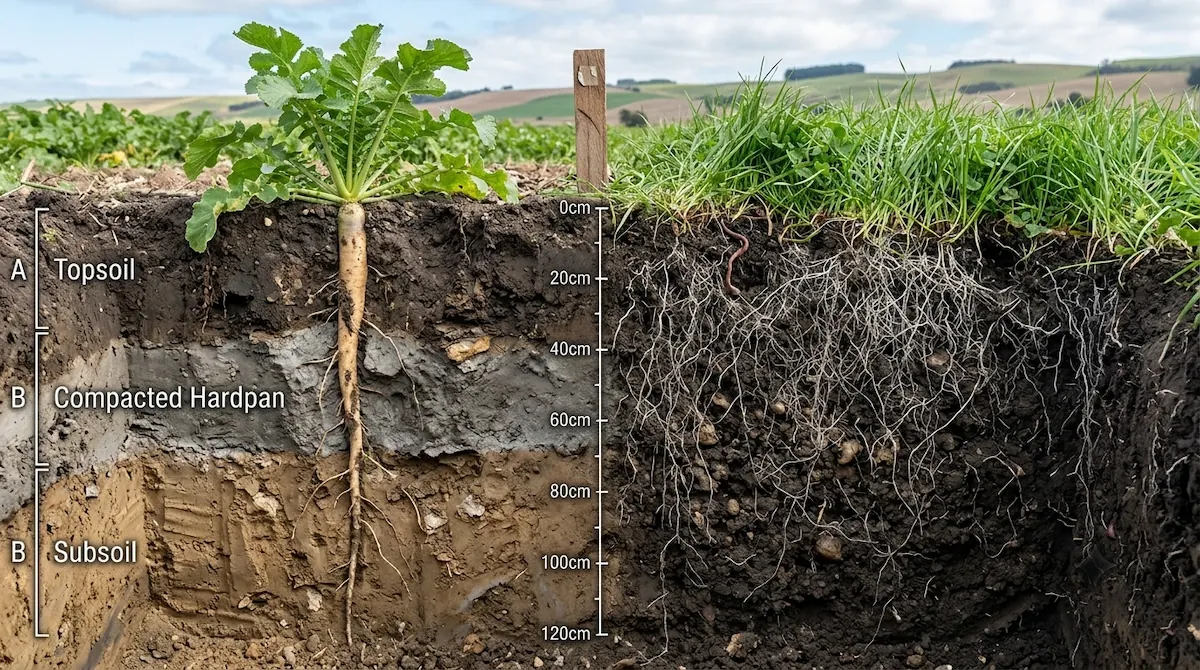
There is a better way, and it costs a fraction of the diesel. Certain cover crops do the drilling for you. Fodder radish sends down a thick, aggressive taproot that forces its way through hardpans that stop other roots dead. When the radish dies and rots, it leaves a deep, open channel behind — lined with old root material that feeds the soil life and keeps the channel from collapsing. The next crop's roots follow those channels straight down.
Grasses work the top layer. Rye, oats and triticale grow a dense mat of fine roots through the upper 30 cm. Those roots feed sugars to soil bacteria and fungi, which make natural glues that bind loose particles into crumbs. That crumb structure is what lets heavy rain soak in instead of sheeting off. Put a deep-boring radish together with a fibrous grass and you fix both problems at once.
A taproot radish opens the subsoil. A fibrous grass builds the topsoil. A mix of both rebuilds the whole profile — and unlike a ripper, the effect gets stronger every season, not weaker.
This is where cover crops pay for themselves. Legumes — plants in the bean and pea family — carry bacteria on their roots that pull nitrogen straight out of the air and fix it into the soil in a form plants can use. Summer legumes that do well here include sunn hemp, cowpea, dolichos (lablab) and pigeon pea. In winter, vetch and clovers do the job.
A good legume stand can fix somewhere between 45 and 220 kg of nitrogen per hectare in a year. When you knock it down, close to half of that becomes available to the trees.
Put real numbers on it. A macadamia orchard aiming for 3 tons of nut-in-shell per hectare needs about 73.5 kg of nitrogen. Rain here already delivers 15 to 40 kg during summer storms, the soil gives roughly 10 kg, and a legume cover can add about 25 kg. Do the sum and the synthetic nitrogen you actually need drops to around 23.5 kg — less than a third of where you started. That can cut your nitrogen bill by more than half.
There is a bonus. Synthetic nitrogen is highly soluble and washes away in a heavy downpour. Nitrogen locked inside a decomposing legume is released slowly, by soil microbes, roughly in step with what the trees are asking for. Less waste, fewer spikes, steadier feeding.
Grasses pull their weight too. Deep-rooted cereals scavenge potassium, calcium and magnesium from down in the subsoil and hold them in their leaves, where they would otherwise leach away. And in our acid soils, where phosphorus normally gets locked up tight, adding cover-crop organic matter can lift available phosphorus four to five times. Mango trials show the same pattern — legume covers raised surface carbon, nitrogen, calcium and potassium sharply in the top layer of soil.9
| Nutrient | Where the cover crop gets it | What it saves you |
|---|---|---|
| Nitrogen (N) | Fixed from the air by legumes (cowpea, vetch, sunn hemp) | 45–220 kg N/ha a year; cuts synthetic N by more than half |
| Phosphorus (P) | Freed up as organic matter coats the reactive soil clays | 4 to 5 times more available P in acid soils |
| Potassium & Calcium | Scavenged from the subsoil by grasses, then returned on top | Stops deep leaching; brings cations back to the root zone |
Most KZN soils are naturally acid, and acid soil hides a nasty problem. Once the pH drops below about 5.5, aluminium comes out of the clay and turns toxic. That aluminium burns the growing tips of roots, leaving them stubby and stunted, so the tree cannot reach water or phosphorus even when they are sitting right there. Citrus is especially sensitive to it.
Lime and gypsum are still the standard fix, and cover crops do not replace them. But some plants add real help at the root zone. Vetch is the standout: in KZN trials it lifted soil pH from a very sour 4.94 up to 6.24, and cut exchangeable acidity by more than half.2 It does this because, as the legume breaks down, it releases basic compounds that neutralise the acid.
Other plants disarm the aluminium directly. Lupins and buckwheat push out organic acids from their root tips that grab hold of the toxic aluminium and lock it into a harmless form, protecting the root.3 Black oats tolerate very low pH and pull calcium up from deep in the soil to the surface, giving a slow, natural liming effect over time.
In acid soil, your fertiliser can be sitting right there and the tree still starves — because toxic aluminium has crippled the roots that should take it up. Fixing the aluminium comes first. Everything else follows.
In our heat, soft green material rots away in days. To armour the soil for the long haul you need woody, high-carbon plant matter. Pigeon pea is made for this. It is a tall, deep-rooted shrub legume that grows a mass of woody stems through summer. Growers cut it and drop it where it stands, laying down a thick mulch that breaks down slowly.
That mulch does more than cover the ground. It blocks the sun, so the soil underneath stays cooler and the fungal networks near the surface survive. It stops water evaporating off the top. And it holds summer rain deep in the profile, ready for the dry mid-season. Pigeon pea leaf-fall alone returns about 40 kg of nitrogen per hectare, on top of everything else, and the plant doubles as a windbreak and shade for young trees.
The water saving is real money. Macadamia growers who switched from bare soil to a managed cover and used a “mow and blow” system — letting the cover grow tall, then mowing it and blowing the cuttings under the trees — cut their irrigation by up to half.6 Bare soil here can run 5°C hotter than mulched soil, which drives huge evaporation losses. With a good mulch mat, some growers stretched the gap between waterings out to six weeks after nut-set without stressing the trees.
For avocados the mulch story is even better. A coarse organic layer under the canopy feeds the soil microbes that fight Phytophthora root rot — the disease that kills more avocado trees than anything else.10 Living covers also let you stop spraying glyphosate to keep the floor clean, which matters, because glyphosate damages avocado's shallow feeder roots.
Cover crops control weeds two ways. The first is straightforward: a fast, dense cover shades the ground so weed seeds never get the light they need to germinate, and the ones that do emerge starve. When you knock the cover down, the flattened mat keeps blocking light and physically holds weeds back.
The second way is quieter. Some plants make their own weedkillers. Rye releases natural compounds from its roots and residue that stop small weed seeds from sprouting. Forage sorghum does the same with a compound called sorgoleone. This is genuinely useful, but there is a catch — these chemicals do not tell the difference between weed seeds and crop seeds, so you leave a waiting gap before planting anything small-seeded into the residue.
For mango growers this adds up fast: where covers have gone in, herbicide use has dropped by around half.8 Just remember to plant a mix, not a monoculture. Leaning on one species too hard can feed soil diseases; one long-time no-till grower lost maize plantings to root rot for exactly that reason. A diverse mix — grasses, legumes and a brassica or two — keeps weeds down without breeding new problems.
A bare, sprayed orchard floor is an ecological desert. It feeds nothing useful and shelters nothing useful. The pests are up in your canopy, and the insects that would eat them have nowhere to live.
Flowers change that. Ladybirds, lacewings, hoverflies and parasitoid wasps all need nectar and pollen to keep going, especially when pest numbers are low. Plant flowering covers — buckwheat, vetch, sunflowers — and you feed a standing army of predators. Add indigenous perennials along your field edges, like aloe, salvia, wild dagga (Leonotis) and wild garlic (Tulbaghia), and you give those predators a permanent home that flowers all year.7
The macadamia results show what this does in practice. Growers who planted mixed covers between the tree rows — lucerne, crown vetch and grasses — found the stinkbugs came down out of the canopy and into the cover, where spiders and ladybirds were waiting. The ladybirds handled the thrips. Nut quality climbed: sound kernel recovery went over 34%, and yields past 4 tons per hectare. The cover did not chase the pests away. It built a place where they get eaten.
Beneficial insects need four things to settle on your farm: Shelter, Alternative food when pests are scarce, Flower-rich habitat, and an Environment free of broad-spectrum insecticides. A flowering cover crop delivers the first three. The fourth is up to you.
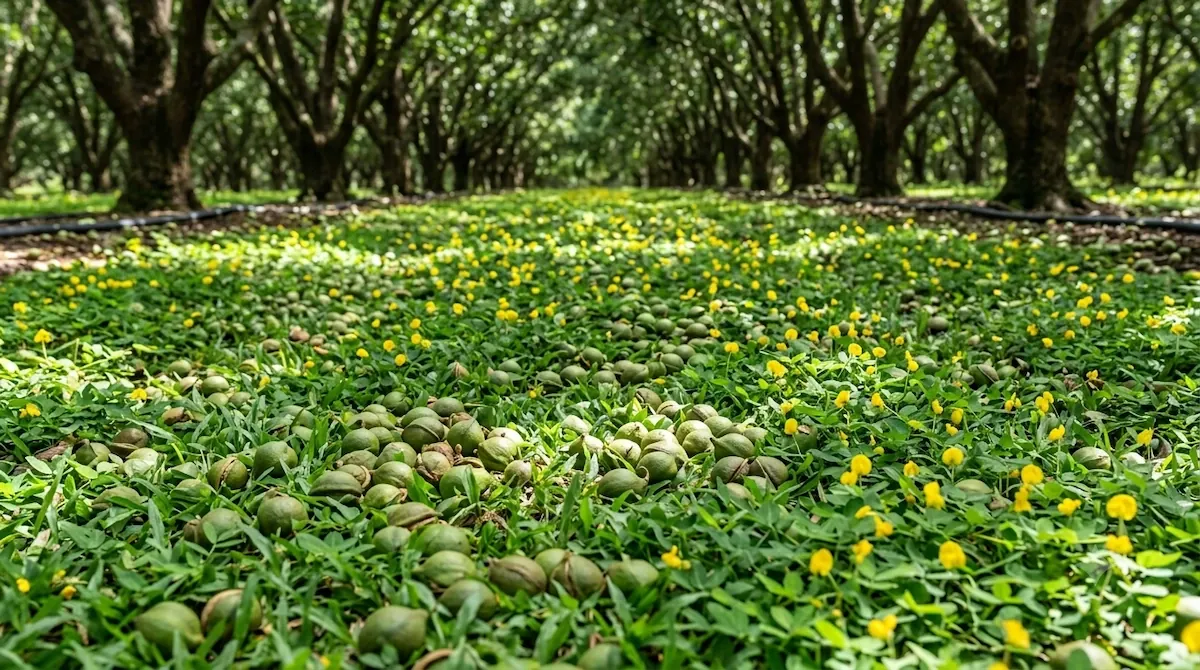
As orchards mature and the canopy closes, less light reaches the floor, and the cover has to cope with shade and with tractor traffic at harvest. Two species handle this best. LM grass (Dactyloctenium australe, also called Berea or sweet smother grass) is indigenous, holds up to 80% cover in deep shade, forms a low flat mat that resists wheels, and — importantly for macadamias — lets nut sweepers work, because the nuts sit cleanly on top of it. Pinto peanut (Arachis pintoi) is a low, non-climbing legume that tolerates shade, fixes nitrogen straight into the floor and takes regular mowing.5
The finer points differ by crop:
Do not try to fix everything in one season. Work out your biggest problem first — is it compaction, sour soil, weeds, pests or water? — and choose a cover crop mix that targets it. As a rule, a mix of two or three species will always beat a single plant, because each one does a different job.
Above all, measure before you plant. A soil test tells you your pH, your aluminium, your nutrient gaps and your compaction, so you pick the right species instead of guessing. Then measure again a season later to see what changed. That loop — measure, read it, act, measure again — is how you turn a bare floor into soil that feeds your trees for the next twenty years.
This is the usual objection, and the answer runs the other way. A living orchard floor works as a mulch that saves water, by shading the surface and cutting evaporation. Bare soil loses moisture to the air and caps over, so rain runs off instead of soaking in.
Yes. Deep-rooting species penetrate compacted layers biologically and leave channels that persist after the plant dies. It is slower than a ripper, but it does not destroy soil structure on the way through, and the channels stay open rather than resealing.
Yes, and it is covered here under fixing sour soil and taming aluminium — which matters particularly in KwaZulu-Natal, where acidity and aluminium pressure are among the defining constraints on orchard soil.
It depends on your crop and on what you are trying to fix. This article sets out how to choose the right floor for macadamias, avocados, citrus, litchis and mangoes, and where to start if you have never planted one.
A cover crop only works when it targets the right problem. A soil health assessment shows you where your ground stands — pH, aluminium, compaction and nutrition — so you plant the right mix the first time, not the third.
Book a Soil Health Assessment